Les ablations simples : Flutter atrial – Tachycardies jonctionnelles
Jean-Philippe DARMON Praticien Hospitalier – Service de Cardiologie – Centre Hospitalier du Mans
Jimmy GUIBERT Infirmier en Electrophysiologie – Service de Cardiologie – Centre Hospitalier du Mans
Juin 2022
On distingue habituellement les ablations simples des ablations complexes selon la nature du trouble du rythme (supraventriculaire), la cible de l’ablation (identifiée sans nécessité de cartographie complexe), la voie d’abord (dans la majorité des cas veineuse fémorale) et le pourcentage élevé de succès avec des risques faibles. Nous envisagerons parmi ces ablations, les 3 plus fréquentes que sont le Flutter Atrial Typique, la Tachycardie par Réentrée Nodale et les Voies Accessoires de type faisceau de Kent. Il ne sera pas abordé l’ablation de la voie nodo hissienne indiquée comme traitement palliatif de la Fibrillation Atriale (FA) rapide du sujet âgé en association avec l’implantation d’un stimulateur cardiaque. L’ablation des voies accessoires atypiques ou de la Tachycardie Jonctionnelle Ectopique, qui sont plus rarement rencontrées, ne sera pas non plus discutée. Comme dans toute ablation, il est important d’avoir une bonne connaissance anatomique et en particulier ici de l’Isthme Cavo Tricuspide (ICT)1,2 et du Triangle de Koch (TK)3 (Figure 1), tout autant qu’électrophysiologique.
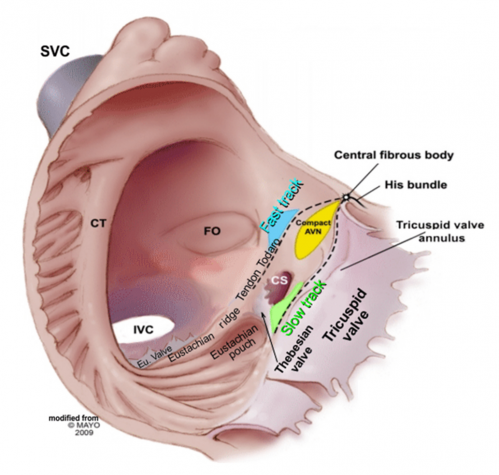 Figure 1 : Représentation schématique de l’Isthme Cavo-Tricuspide (ICT) et du Triangle de Koch (TK). L’ICT, limité en avant par le bord inférieur de l’Anneau Tricuspide, est composé des muscles pectinés et d’une poche Eustachienne plus ou moins proéminents et se termine en arrière par la valve d’Eustachi et le bord antérieur de la VCI. Le TK est délimité en avant par le bord antérieur de l’anneau tricuspide en regard de la valve septale, en haut par le NAV compact, en arrière par le tendon de Todaro et en Bas par l’OSC.
Ablation du Flutter Atrial Typique
Le Flutter Atrial Typique est une macro réentrée utilisant un passage obligé par l’ICT. Le circuit se déroule autour de l’orifice tricuspide et l’on distingue, selon le sens de rotation sur une vue du cœur en Oblique Antérieur Gauche (OAG), le Flutter Atrial Typique Antihoraire, qui est le plus fréquent, du Flutter Atrial Typique Horaire ou Inverse, qui est 10 fois plus rare 4 (Figure 2). Schématiquement, dans le Flutter Antihoraire, la remontée se fait par le Septum Inter Atrial (SIA) et la descente par la paroi latérale de l’oreillette droite (ODL) avec ensuite un passage ralenti par l’ICT, les techniques de cartographie de haute densité ayant permis de détailler de manière plus précise ce circuit 5. Le sens de rotation est inverse dans le Flutter Horaire. Plus rarement il peut s’agir d’un circuit autour de la veine cave inférieure (Boucle inférieure ou Lower Loop Reentry) ou autour de l’Orifice du Sinus Coronaire (OSC) (Flutter Intra Isthmique) avec toujours dans les 2 cas un passage obligatoire par l’ICT 6,7. Il peut aussi y avoir une double boucle l’une typique et l’autre atypique par exemple péri cicatricielle droite.
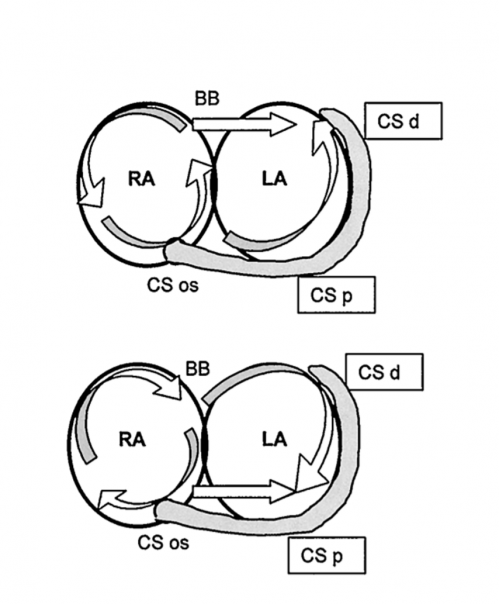 Figure 2 : Schéma de l’activation du Flutter Atrial Typique dépendant de l’ICT. Le circuit se déroule autour de l’orifice tricuspide. Dans la forme la plus fréquente (en haut), le sens de rotation est Anti-Horaire avec descen
te par l’ODL, passage ralenti dans l’ICT, remontée par le SIA et, de façon concomittante, par l’intermédiaire du SC, activation de l’OG qui s’effectue de bas en haut. Dans la forme la plus rare (en bas), le sens de rotation peri tricuspidien est inverse, Horaire, l’activation de l’OG s’effectuant essentiellement par le faisceau de Bachman donc de haut en bas.
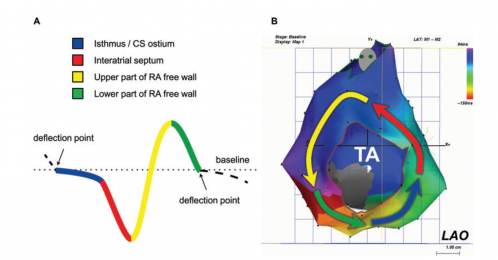
Figure 3 : Flutter Atrial Typique Anti-Horaire. Correlation entre l’activation endocavitaire et l’ECG en D2. Le plateau sur l’ECG correspond au passage ralenti dans l’ICT qui s’effectue dans le sens antihoraire de sa portion latérale à sa portion septale proche de l’OSC (en bleu). La portion descendante de la négativité correspond à la remontée sur le SIA (En rouge). La portion ascendante de la négativité et la partie initiale du ressaut positif correspond à la descente sur la paroi latérale haute (En jaune). La fin du ressaut positif correspond à la fin de la descente sur la paroi latérale basse jusqu’à l’arrivée à l’ICT(En vert).
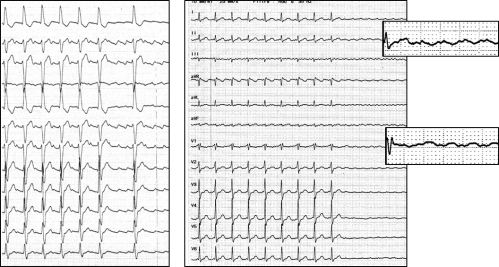
Figure 4: ECG 12 dérivations. Flutter Atrial Typique Anti-Horaire ( A gauche) : Négativité en D2, D3, aVF suivie d’un faible ressaut positif puis d’un plateau descendant ou négatif, cet aspect étant retrouvé aussi en V5, V6 mais pas en V1 où l’auriculogramme est positif, étroit et survient après la négativité en D2, D3, aVF. Flutter Atrial Typique Horaire (A droite) : Prédominance de positivité avec aspect bifide en D2, D3, aVF qui est retrouvée aussi en V5, V6 mais pas en V1 où l’auriculogramme est négatif, bifide et prolongé en w.
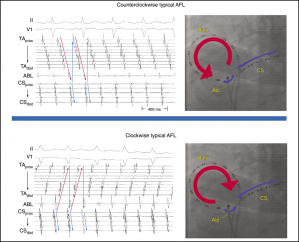 Figure 5 : Activation endocavitaire. Flutter Atrial Typique dépendant de l’ICT Anti Horaire (A) : Descente par l’ODL, passage dans l’ICT puis remontée par le SIA et activation de l’OG par l’intermediaire du SC et Horaire (B) : Montée par l’ODL, descente par le SIA avec activation de l’OG via le faisceau de Bachman, puis passage dans l’ICT
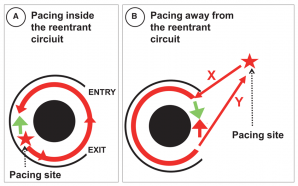 Figure 6 : Représentation schématique du principe d’entrainement d’une tachycardie avec cycle stable. A gauche : Lorsque le site de stimulation (Etoile rouge) est situé dans le circuit, il se produit un bras antidromique (flèche verte) qui va entrer en collision avec la tachycardie et un bras orthodromique qui accélère la tachycardie au cycle de stimulation (entrainement). A l’arrêt de la stimulation, le cycle de retour (Intervalle entre le dernier spike et le 1er auriculogramme) est égal au cycle de la tachycardie (avec une tolérance de 20 à 30 ms) ce qui confime que l’électrode de stimulation est dans le circuit. A droite : Lorsque le site de stimulation est à distance du circuit, le même phénomène se produit avec un cycle de retour augmenté du temps pour aller du site de stimulation au circuit et du temps de retour du circuit au site de stimulation.
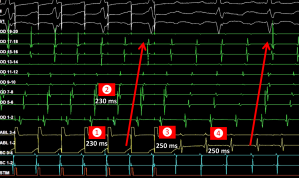 Figure 7 : Entrainement d’un flutter typique à rotation horaire. En cours de flutter avec un cycle régulier de 250 ms, il est délivré une stimulation continue à 230 ms au niveau de l’ICT (1). Le flutter s’accélère à la fréquence de stimulation (2) – avec une séquence d’activation identique à celle du flutter - et l’on observe, à l’arrêt de celle-ci, un temps de retour, mesuré entre le dernier spike et le premier auriculogramme au niveau de l’ICT, (3) identique au cycle du flutter (4) . Cela permet de dire que le site de stimulation est exactement dans le circuit du flutter et qu’il est donc dépendant de l’ICT.
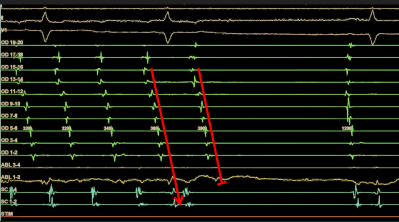
Figure 9 : Ablation par radiofréquence d’un flutter atrial typique à rotation anti horaire. En cours de tir, le cycle du flutter s’allonge progressivement puis le flutter s’interrompt après la dépolarisation de l’ODL basse et avant celle du SC donc bien au niveau de l’ICT où est délivré le traitement.
L’ablation par radiofréquence est effectuée en sélectionnant, avec un contrôle de température, des valeurs de 60 W – 60 °C avec l’électrode de 8 mm non irriguée et de 30 à 40 W – 42°C avec l’électrode de 4 mm irriguée. Elle est débutée au niveau du versant antérieur de l’ICT avec ensuite, soit application point par point, soit retrait progressif et continue (dragging) du cathéter, dans les 2 cas jusqu’au versant cave (Figure 8). La présence de muscles pectinés développés, d’une poche sous eustachienne ou d’une crête d’Eustachi proéminente peuvent représenter des difficultés et il convient alors de déplacer la ligne d’ablation en position un peu plus septale ou latérale, d’utiliser une longue gaine et/ou un cathéter irrigué 1.
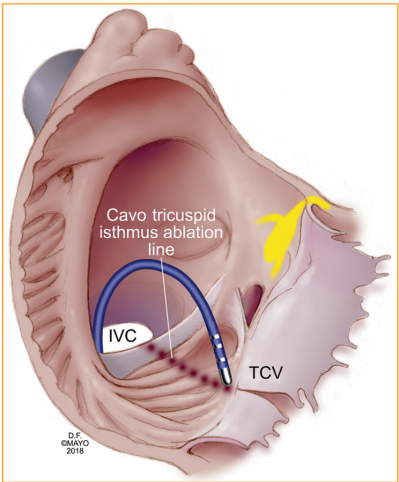 Figure 8 : Ligne d’ablation continue au niveau de l’ICT de son versant tricuspide jusqu’au versant cave ce qui permet l’arrêt du Flutter et empêche, si la ligne est parfaitement continue, le circuit de se reformer.
Le but de l’ablation est d’obtenir un bloc complet bidirectionnel de l’ICT. Le bloc horaire est validé en stimulation de l’OSC lorsque que l’on obtient une activation complètement descendante sur la sonde OD et, sur toute la longueur de l’ICT, des doubles potentiels (DP) espacés d’une valeur constante d’au moins 100 ms (Figure 10). En cas de doute sur la séquence d’activation OD ou au niveau des DP, ce qui peut être lié une perméabilité de la Crista Terminalis, la stimulation de la berge septale de la ligne d’ablation 13 ou la stimulation différentielle septale 14 permet de distinguer bloc incomplet et complet. Lorsque le bloc est obtenu en horaire (en stimulation de l’OSC), on considère qu’il est bidirectionnel mais il est habituel de la valider aussi en antihoraire. Pour cela la stimulation OD basse avec les mêmes critères sur les DP au niveau de la ligne d’ablation ainsi que la stimulation différentielle de l’OD latérale permet de le confirmer.
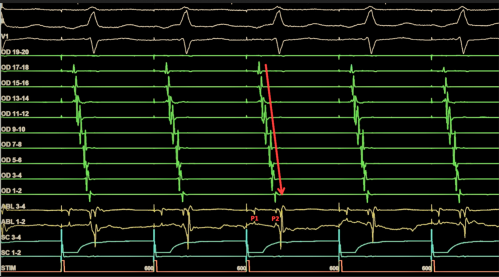 Figure 10 : Bloc complet de l’ICT dans le sens horaire. En stimulation de l’OSC, on enregistre par la sonde duodécapolaire positionnée au niveau de l’ODL avec l’extrémité distale au plus près de la ligne d’ablation, une activation complètement descendante. De plus, il y a, au niveau de la sonde d’ablation située dans l’ICT, des doubles potentiels espacés de plus de 100 ms. Le premier potentiel (P1) survient immédiatement après la stimulation de l’OSC et le second (P2) après que l’activation ait contourné l’orifice tricuspidien en remontant par le SIA et en descendant par l’ODL jusqu’à la ligne de radiofréquence.
Les complications rapportées sont très rares (Epanchement péricardique voire Bloc Atrioventriculaire). Lors du suivi à moyen et long terme le risque de récidive de Flutter Typique est faible (5%) mais pas celui de survenue de FA (au minimum 20 % même en l’absence d’antécédent de FA) 15. Le traitement anticoagulant, qui est bien sûr maintenu sans interruption lors de l’ablation, est poursuivi ensuite au moins 1 moins et sur le long terme si le score de CHA2DS2-VASc est à 1 ou à partir de 2.
Ablation de la Tachycardie par réentrée Nodale
Le circuit exact de la tachycardie reste encore incomplètement compris ce qui n’empêche cependant pas la réalisation d’une ablation efficace. Dans la forme typique, on considère qu’il emprunte en antérograde la voie lente nodale (dans la grande majorité des cas l’extension inférieure droite du NAV et beaucoup plus rarement l’extension inférieure gauche) et en rétrograde la voie rapide. Dans les formes atypiques, le circuit se fait soit en sens inverse c’est-à-dire en antérograde par la voie rapide et en rétrograde par l’extension droite ou gauche de NAV soit entre les 2 extensions inférieures du NAV 3 (Figure 11). L’indication de l’ablation est retenue en cas de forme symptomatique et récidivante 9
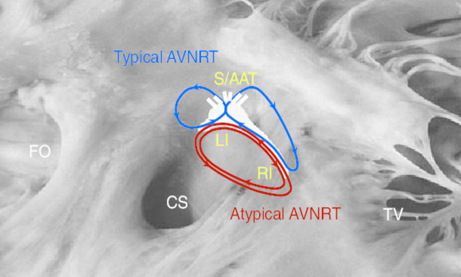 Figure 11 : Tachycardie par réentrée nodale. Dans la forme typique (en bleu), le circuit utilise en antérograde l’extension inférieure droite (RI : Right Inferior) du NAV et en rétrograde la voie rapide. Dans de très rares cas, il emprunte en antérograde l’extension inférieure gauche (LI : Left Inferior) du NAV et toujours la voie rapide en rétrograde. Dans la forme atypique, le circuit se fait soit en sens inverse c’est-à-dire en antérograde par la voie rapide et en rétrograde par l’extension droite ou gauche de NAV soit entre les 2 extensions inférieures du NAV le circuit utilise les 2 extensions du NAV dans un sens ou dans l’autre.
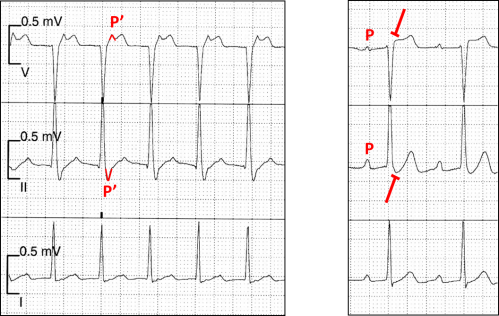 Figure 12 : ECG d’une tachycardie par réentrée nodale. Tachycardie régulière à QRS fins avec activité atriale rétrograde visible à la fin du QRS sous la forme d’une pseudo onde S en D2 et d’une pseudo onde r’ en V1. La nature atriale de ce potentiel est confirmé car il n’est pas retrouvé en sinusal.
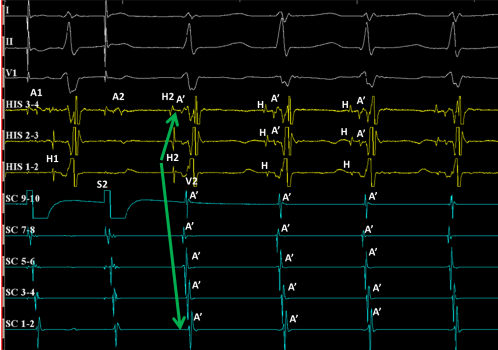 Figure 13: Tachycardie par réentrée nodale. Tachycardie supraventriculaire avec cycle régulier, relation AV 1/1, intervalle HA court à 30 ms et primo dépolarisation au niveau du his avec activation atriale concentrique.
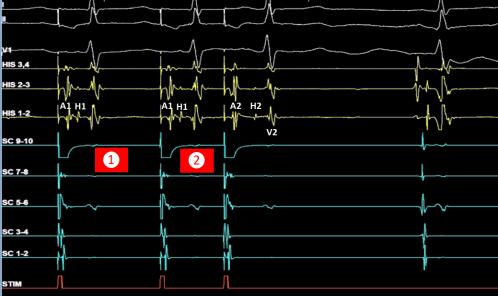
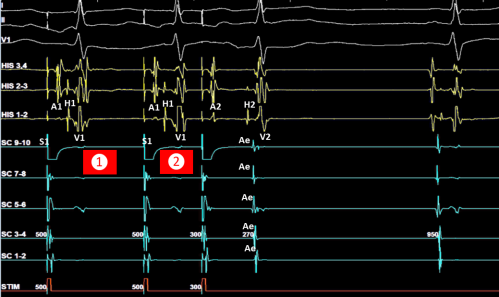
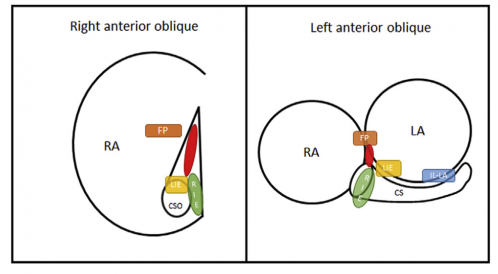
Figure 15 : Site d’ablation efficace de la tachycardie par réentrée nodale. Dans la grande majorité des cas, il est en avant ou très légèrement au dessus de l’OSC et sur le versant ventriculaire ce qui correspond à l’extension inférieure droite du NAV. En cas d’échec, l’ablation pourra être faite au niveau du toit du SC voire, via un cathétérisme transseptal, au niveau de l’anneau mitral inféro septal ce qui correspond à l’extension inférieure gauche du NAV
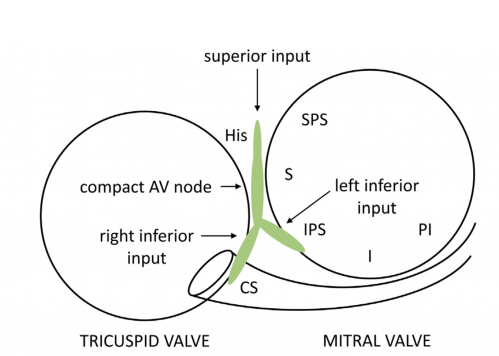
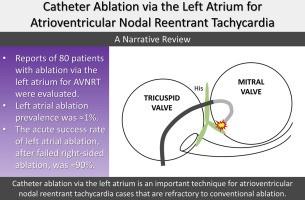 Figure 16 : Cathétérisme transseptal permettant d’atteindre l’extension inférieure gauche du NAV au niveau du SIA bas.
Pendant l’ablation par radiofréquence, il est fréquemment observé un rythme jonctionnel accéléré (RJA) (figure 17 et 18) au site efficace traduisant l’atteinte de la voie lente avec conduction vers les ventricules par le His et, de façon simultanée, vers les oreillettes par la voie rapide. Cette conduction par la voie rapide lors du RJA permet de s’assurer de l’intégrité de celle-ci et d’interrompre immédiatement le tir si elle se prolonge ou s’interrompt afin d’éviter un Bloc Auriculo Ventriculaire (BAV). La difficulté principale est d’obtenir une bonne stabilité du cathéter et il peut être nécessaire d’utiliser une longue gaine. Lorsque l’on utilise la cryothérapie le site d’ablation efficace est un peu plus haut et un peu plus sur le versant atrial, la cryoadhésion permettant de maintenir le cathéter en position stable et la phase de cryomapping préalable à l’ablation faisant interrompre le tir en cas d’allongement de l’intervalle PR avec ensuite normalisation constante et rapide de la conduction. Le but est dans tous les cas d’obtenir la disparition complète de la conduction dans la voie lente (Ablation) ou la persistance de la conduction dans cette voie lente mais sans écho nodal ou avec un seul écho et sans tachycardie nodale inductible (Modulation), les résultats étant sensiblement les mêmes dans les 2 situations. La cryoablation est un peu moins efficace que l’ablation par radiofréquence (90 % vs 95 à 98%) avec des récidives parfois tardives 18 mais sans risque de BAV (0.5 % vs 0%) ce qui peut la faire préférer en 1ère intention chez les jeunes patients.
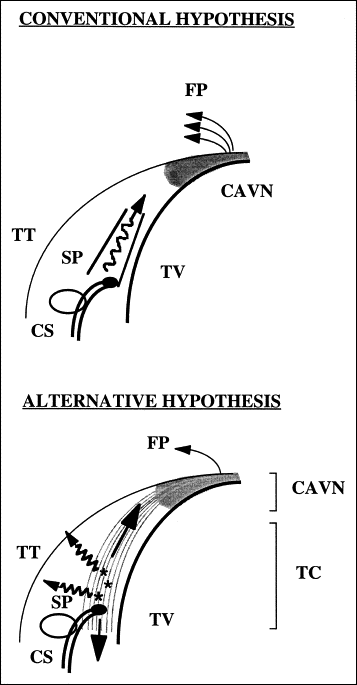 Figure 17 : Représentation schématique du rythme jonctionnel accéléré induit lors de l’ablation par radiofréquence. Pendant l’ablation par radiofréquence, il est fréquemment observé un rythme jonctionnel accéléré au site efficace traduisant l’atteinte de la voie lente avec conduction vers les ventricules par le His et, de façon simultanée, vers les oreillettes par la voie rapide. Cette conduction par la voie rapide lors du RJA permet de s’assurer de l’intégrité de celle-ci et d’interrompre immédiatement le tir si elle se prolonge ou s’interrompt et d’éviter un BAV.
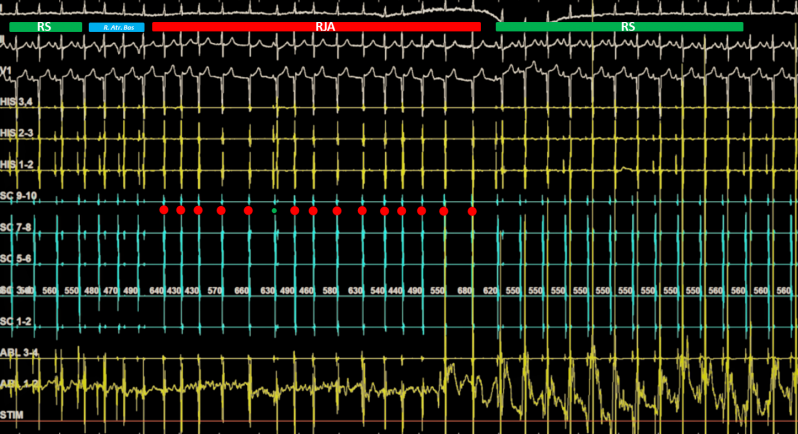 Figure 18 : Rythme jonctionnel accéléré lors de l’application du courant de radiofréquence au niveau de la voie lente. Après 4 cycles en rythme sinusal (en vert) puis 3 cycles en rythme atrial bas (En bleu. Onde P négative en D2, D3, AVF), on observe un rythme jonctionnel accéléré (En rouge) avec conduction rétrograde stable en 1/1 (Points rouges) traduisant la conduction par la voie rapide et donc son intégrité alors que la radiofréquence est délivrée au niveau de la voie lente qui est relativement proche.
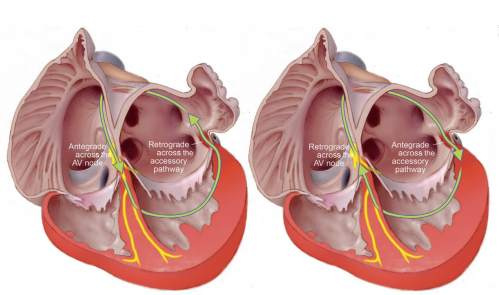
Figure 19 : Tachycardie Orthodromique utilisant la VNH en antérograde et le faisceau de Kent en rétrograde (A) et Tachycardie Antidromique utilisant le faisceau de Kent en antérograde et la VNH en retrograde (B)
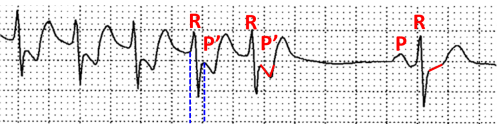
Figure 20 : Tachycardie Orthodromique utilisant en rétrograde un Kent postérieur. Tachycardie régulière à QRS fins avec activité atriale négative en D2 et RP’ à 90 ms produisant un pseudo sous décalage du segment ST. L’arret de la tachycardie s’effectue sur une onde P avec ensuite dès le premier complexe sinusal qui suit l’arret de la tachycardie une normalisation complète de ST confirmant bien qu’il s’agissait bien d’une activité atriale rétrograde localisée dans ST et non un trouble de la repolarisation.
L’EEP s’effectue par voie veineuse fémorale avec nécessité, en cas de VA gauche, d’un abord rétro aortique ou transseptal. Il est mis en place habituellement 2 à 3 sondes diagnostiques (Quadripolaire au niveau du His, Décapolaire au niveau du SC et éventuellement Quadripolaire VD et/ou OD) et une sonde d’ablation par Radiofréquence ou plus rarement par Cryothérapie. Elle a pour but de prouver qu’il existe une VA et que la tachycardie utilise de manière obligatoire cette VA. La stimulation atriale continue ou programmée induit un incrément de AH avec diminution de HV, AV constant et élargissement du QRS traduisant la présence d’une conduction par une VA antérograde. La conduction rétrograde est non décrémentielle avec une séquence d’activation atriale variable selon l’insertion de la VA et un comportement spécifique lors des manœuvres de stimulation programmée, différentielle basale ou apicale ou para-hissienne. Il est enfin important de prouver que la VA participe obligatoirement à la tachycardie. Pour cela plusieurs manœuvres peuvent être utilisées dont la plus classique est, en cours de tachycardie, l’anticipation atriale sans modification de séquence lorsqu’une ESV programmée est délivrée en période réfractaire du His.
Le principe du traitement est l’ablation de la VA sans atteinte de la voie nodo-hissienne ou autre structure voisine. L’énergie utilisée est en règle la radiofréquence sans ou avec irrigation de l’électrode active et plus rarement la cryoablation lorsque la VA est proche de la VNH. Les critères en faveur d’un site d’ablation efficace sont, sur la conduction antérograde, en rythme sinusal (Figure 21), un intervalle AV local court ≤ 40 ms avec V-Delta < 0 et un aspect « PQS » en unipolaire. Sur la conduction rétrograde, en tachycardie orthodromique (Figure 22) ou en stimulation ventriculaire (Figure 23), on retiendra un intervalle VA court et un électrogramme atrial négatif en unipolaire. La conduction par la voie accessoire disparait alors en règle dans les toutes premières secondes du tir. Le pourcentage de succès est élevé proche de 100% mais il existe des situations potentiellement difficiles liées à la proximité de la VNH ou à des localisations inhabituelles. Les effets indésirables sont réduits avec avant tout le risque de BAV en cas de VA située à proximité de la VNH.
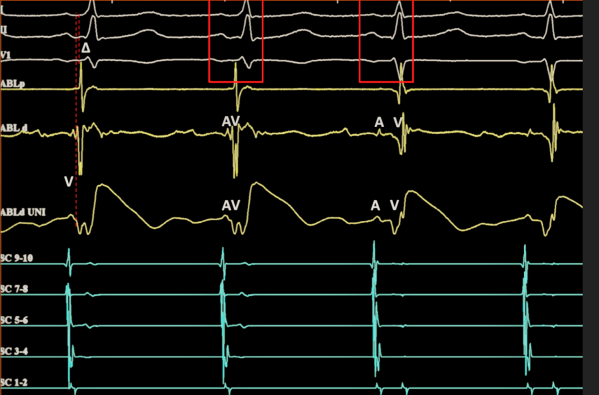 Figure 21 : Ablation d’une VA latérale G sur la conduction antérograde en rythme sinusal. Site efficace avec, sur la sonde d’ablation, intervalle AV local court et fusion locale , précession de 10 ms de V local sur le début de l’onde delta, aspect QS de la dépolarisation ventriculaire en unipolaire et disparition immédiate de la préexcitation dès le début du tir de radiofréquence.
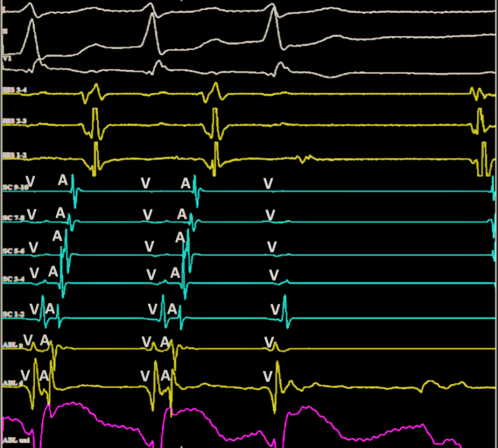
Figure 22 : Ablation d’une VA latérale G sur la conduction rétrograde en cours de tachycardie orthodromique. Site efficace avec, sur la sonde d’ablation, intervalle VA local court, aspect « QS » de la dépolarisation atriale en unipolaire et disparition immédiate de la conduction rétrograde par la voie accessoire qui se fait ensuite par la VNH.
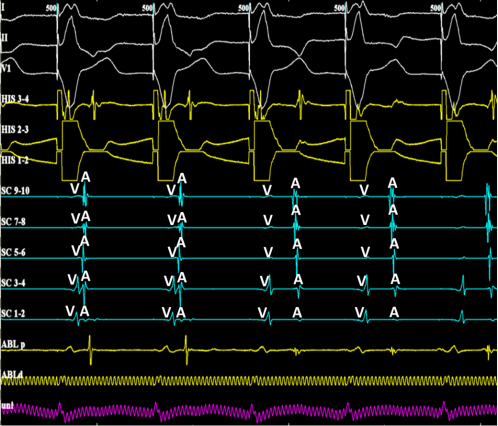
Figure 23: Ablation d’une VA postéro latérale G sur la conduction rétrograde en stimulation ventriculaire. Site efficace avec disparition immédiate de la conduction par la voie accessoire rétrograde (Primo dépolarisation au SC médian 5-6 avec fusion VA) qui se fait ensuite par la VNH (Primo dépolarisation au SC proximal 9-10 avec VA long).